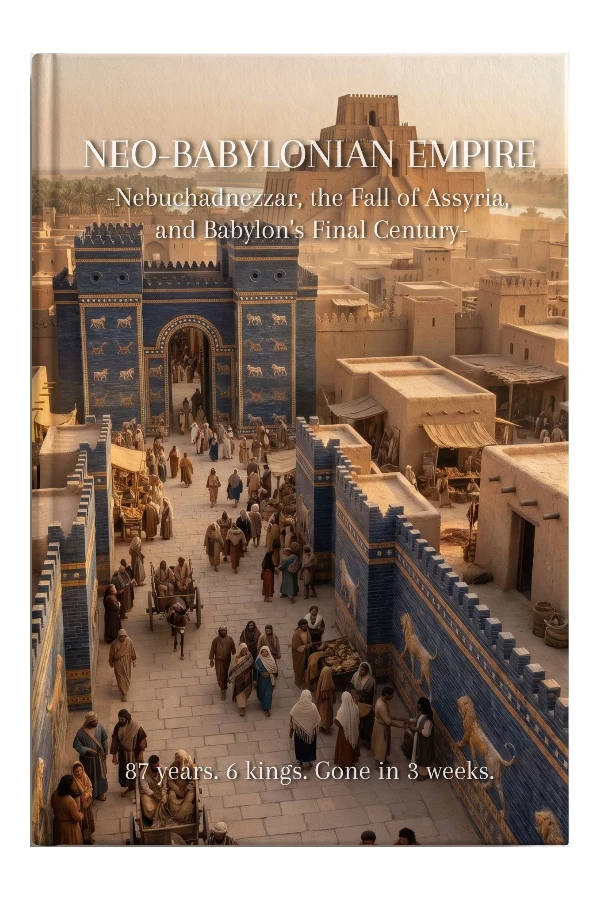
Neo-Babylonian Empire: Nebuchadnezzar, the Fall of Assyria, and Babylon's Final Century
Understand How Mesopotamia's Last Great Power Rose, Ruled, and Fell, Told Through Its Own Clay Records
Description: In 626 BC Babylon was a subject province with a ruined past and a foreign overlord. Within twenty years its new king had helped destroy Nineveh; within forty, his son ruled from the Persian Gulf to the edge of Egypt from a capital that was the largest city of its age. In 539 BC the whole structure passed to Cyrus of Persia after a campaign of a few weeks. This book tells that story from the evidence up. The Babylonians left an enormous record of receipts, contracts, temple accounts, and sky observations, and almost no account of their own battles. Reading those sources side by side with Hebrew scripture and the Greek writers, this history shows what can be known about Babylon's final empire, what cannot, and why the most famous "facts" are often the weakest. A look inside: seven of the 23 chapters Chapter 1 — What "Neo" Actually Means The Babylonians never called themselves an empire, or even Babylonians. You will be able to read any source on the period without tripping over its competing names. Chapter 8 — Judah, Tyre, and the Egyptian Frontier A Babylonian chronicle dates the capture of Jerusalem to a day in March 597 BC. See where that record and the biblical account agree, and settle whether Egypt was ever conquered. Chapter 12 — Babylon, the City as an Argument A walled capital of some 850 hectares, faced in fired brick on a treeless plain. Understand how the Ishtar Gate's glazed animals were made and what the city's layout was built to say. Chapter 14 — The Hanging Gardens The best-known wonder of Babylon is missing from every Babylonian record. Weigh the three explanations scholars defend, including the case for Nineveh. Chapter 16 — Silver, Dates, and Debt Loans at a customary 20 percent a year and a price record kept for centuries. Learn how silver, date palms, and family firms paid for the building programme. Chapter 19 — Watching the Sky Temple scholars recorded the heavens for about six hundred years. Follow the line from celestial omens to the sixty-minute hour and the 360-degree circle. Chapter 22 — Nabonidus, Cyrus, and the Fall One battle at Opis, one surrender at Sippar, and a capital entered without a fight. Compare the explanations for a collapse that took weeks rather than generations. Other chapters cover the Assyrian century before the empire, the Chaldean question, the army and siege warfare, government and provinces, religion and the New Year festival, society and family law, language and cuneiform, art and objects, the exile in Jewish history, and what happened to Babylon from Persian rule to its listing as a World Heritage Site. Written for curious general readers, students, and teachers. No prior knowledge of the ancient Near East is assumed.
Book video
- Genre
- History & civilization
- Format
- Ebook