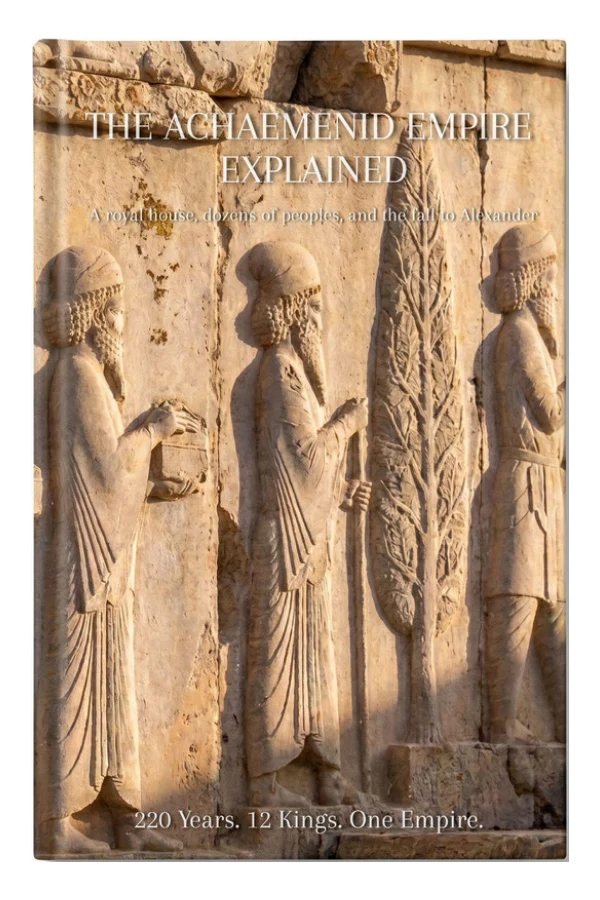
The Achaemenid Empire Explained
Understand How a Royal House from Southern Iran Governed Dozens of Peoples for Two Centuries, and Why Alexander Brought It Down
Around 550 BCE, a king from a highland valley in southern Iran defeated his Median overlord. Within a generation his family ruled from the Aegean Sea to the Indus River, governing tens of millions of people who shared no common language, religion, or capital. The Achaemenid Empire Explained tells how that state was built, how it functioned for two centuries, and why it collapsed in a handful of years before Alexander of Macedon. For generations, readers knew the Persians mainly through their enemies: Greek historians and biblical writers. This book brings in the empire's own voice, from trilingual royal inscriptions and the clay administrative tablets of Persepolis to Aramaic letters written by a Persian governor, while treating every source, Persian or Greek, with the same critical eye. A look inside: seven chapters Chapter 6, The Crisis of 522 BCE and the Rock of Behistun. A king carves his own version of how he came to power a hundred meters up a cliff. You will learn to read royal propaganda as both evidence and argument. Chapter 8, Governing Many Peoples: Satraps, Tribute, and the King's Eye. Governors with wide powers, and a king who needed to know what they were doing. You will see how a vast realm was run through delegation and overlapping checks. Chapter 9, The Royal Road and the Imperial Courier System. A message service that amazed the Greeks and still echoes on a famous New York building. You will understand why communication was a pillar of imperial control. Chapter 14, Ahuramazda and the Gods of the Empire. Were the kings Zoroastrian? You will be able to weigh the evidence on both sides of a debate that still divides specialists. Chapter 15, Workers, Queens, and the Clothes of Empire. Clay tablets record rations, estates, and the women who controlled them. You will meet the people behind the palace reliefs. Chapter 20, Darius III, Alexander, and the End of the Empire. Three great battles in four years, and a king betrayed by his own nobles. You will follow the fall step by step and see why the usual portrait of Darius III is being reconsidered. Chapter 21, Why It Lasted, Why It Fell: The Kings in Order and the Shape of Two Centuries. A reference list of every king, a compact timeline, and a structured analysis. You will come away with a clear framework for the whole period. Written for curious general readers, students, and travelers, the book explains terms when they first appear, flags where the evidence is thin, and ends with a reading guide and bibliography for anyone who wants to go further.
- Genre
- History & civilization
- Format
- Ebook
Where to read
Verified links to stores will appear here when available.