The Early Dynastic I Period
What Archaeology Actually Knows About Sumer's Earliest Walled Cities
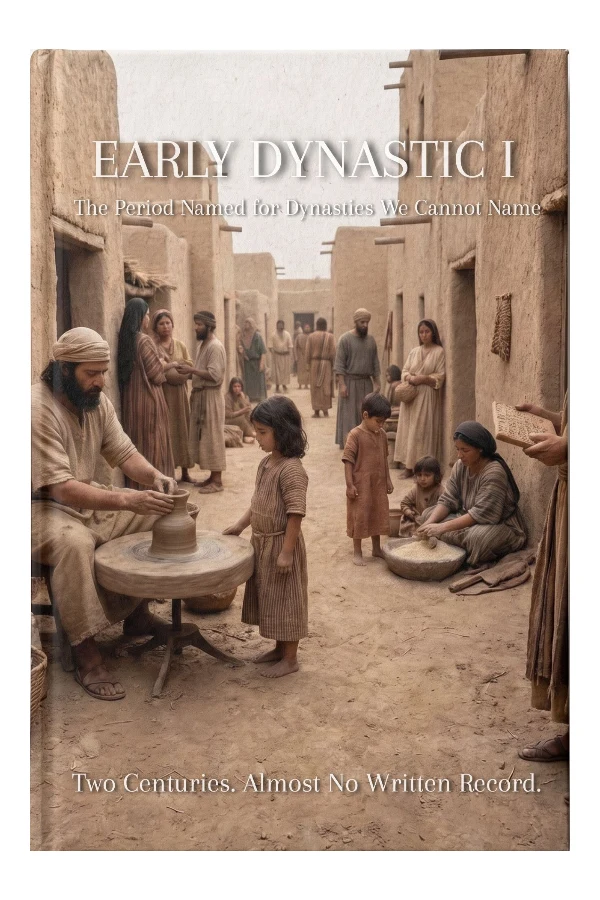
Open three reference works on early Mesopotamia and you will find three different date ranges for the same period, each hedged with a slash. That is not sloppiness. It is the visible seam of a chronological scheme assembled in the 1930s from two temple sequences in a single river valley, and applied ever since to a region it was never built to describe. This book takes that problem as its subject rather than papering over it. Between the archaic clay tablets of Uruk and the gold-filled shaft graves of Ur lies an interval of roughly two centuries in which the cities of the southern Iraqi plain walled themselves in, temples took the form they would hold for two millennia, and the administrative apparatus of Mesopotamian life took shape. Almost nobody wrote it down. Archaeologists call the interval Early Dynastic I, and the name carries an irony that specialists notice at once: it is named for dynasties whose members cannot be named. What follows is an attempt to say what can honestly be said, and to mark clearly where the evidence stops. A look at what is inside: Chapter 2, Frankfort in the Diyala — How a single well-funded excavation on the plain's northeastern margin came to define the chronology of an entire region, and what that accident cost. You will understand why the scheme in every textbook rests on foundations most readers have never heard of. Chapter 3, Fixing the Dates — Why the calendar dates carry error bars of a century, tracing the chain of inference from astronomical observations down through the archaeological sequence. You will stop reading period charts as though their numbers were measurements. Chapter 8, Walls — What it actually took to raise a circuit wall running nine kilometres out of hand-shaped mud brick, and what the labour arithmetic proves about the institution that ordered it. You will see how a monument can testify to organisational capacity while saying nothing about who held power. Chapter 13, Writing — Why the best-documented civilisation of the ancient world went nearly silent for two centuries after inventing the script, and what the surviving fragments still reveal. You will grasp why this period must be read through objects rather than words. Chapter 18, Assembly and Community — The long-running argument over whether these earliest cities were ruled by kings at all, or governed by assemblies of their own householders. You will see how a claim made in the 1940s reshaped the study of early state formation, and where it stands now. Chapter 19, Burial and Social Difference — What graves reveal about inequality, from ordinary pit burials with two pots to the cart burials at Kish, and why the truly spectacular tombs come later. You will learn to read wealth from a grave without over-reading it. Chapter 21, Conflict, the King List, and the Manufacture of Memory — How a silent stretch of time acquired kings, dynasties, and a flood, centuries after the fact, and why the document supplying them is better evidence about its own era than about this one. For readers who came to Mesopotamia through Gilgamesh and want to know whether the wall was real; for students who noticed that the dates hedge; for anyone who suspects that popular accounts of the world's earliest cities speak with more confidence than the excavations support. Roughly 45,000 words across twenty-one chapters, with an introduction, a conclusion, and a bibliography organised by evidence type.
Book video
- Genre
- History & civilization
- Format
- Ebook