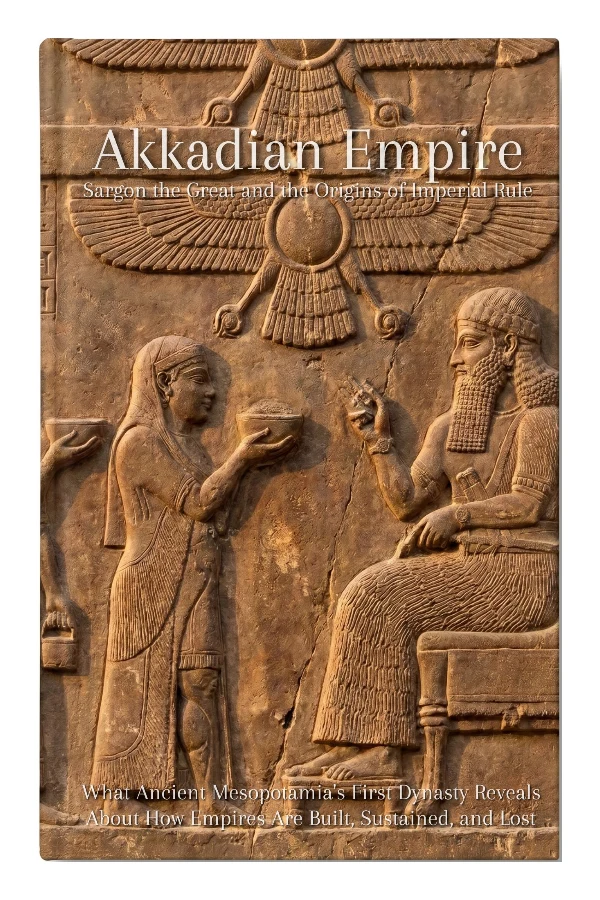
Akkadian Empire: Sargon the Great and the Origins of Imperial Rule
c. 2334–2154 BCE
What Ancient Mesopotamia's First Dynasty Reveals About How Empires Are Built, Sustained, and Lost
Before Egypt's New Kingdom, before Persia, before Rome — there was Akkad. Around 2334 BCE, Sargon seized a Mesopotamian city-state and spent the next five decades building something the ancient world had never seen: a multi-ethnic empire governed from a single center, held together not just by force but by administrative innovation, a shared official language, and a professional army that answered directly to the palace. This book traces that achievement across thirteen chapters, from the founding of the empire to the climate-driven collapse that ended it — and explains what made the Akkadian model so influential that later empires from Assyria to Persia were still borrowing from it two thousand years after Akkad itself had been forgotten. Digest Table of Contents Chapter 2: The Rise of Sargon the Great From cupbearer to conqueror — how a man of obscure origins built the ancient world's first multi-ethnic state, and what administrative choices made it durable. Reader benefit: Understand the specific political and military decisions that transformed a city-state takeover into the founding moment of a new political form. Chapter 4: Political System and Governance The birth of centralized administration — appointed governors, standardized records, unified weights and measures, and the logic behind each innovation. Reader benefit: See how the empire solved the fundamental problem of governing people who did not share a language, religion, or culture. Chapter 6: Economic Systems and Trade Networks How Akkadian merchants reached the Indus Valley, why long-distance trade required imperial infrastructure, and what the exchange of tin and lapis lazuli reveals about Bronze Age economic connectivity. Reader benefit: Trace the economic architecture that funded the empire and connected the ancient Near East to South Asia. Chapter 8: Religion and the Gods Enheduanna's hymns, the deification of Naram-Sin, and how the Akkadian court used religious synthesis to bind a multi-ethnic empire together. Reader benefit: Understand how religious policy functioned as a governance tool, and encounter the earliest attributed author in recorded history. Chapter 11: Naram-Sin and the Empire at Its Peak The campaigns, the Victory Stele, the divine title — and the first signs that the empire was stretching beyond what its administrative structure could sustain. Reader benefit: See the empire at its height and understand what made it simultaneously impressive and fragile. Chapter 12: Decline and Collapse — The 4.2 Kiloyear Event What ice cores, lake sediments, and cuneiform texts reveal about the drought that destabilized the northern provinces and accelerated the empire's end. Reader benefit: Follow the current scientific and historical debate about climate change as a factor in imperial collapse, and draw your own conclusions. Chapter 13: Archaeological Discoveries and Sites A century of excavation, the artifacts now held in London, Paris, and Baghdad, and the still-unsolved mystery of Agade's location. Reader benefit: See where the evidence for everything in this book actually comes from — and what remains genuinely unknown. Available in Kindle Unlimited.
- Genre
- History & civilization
- Format
- Ebook