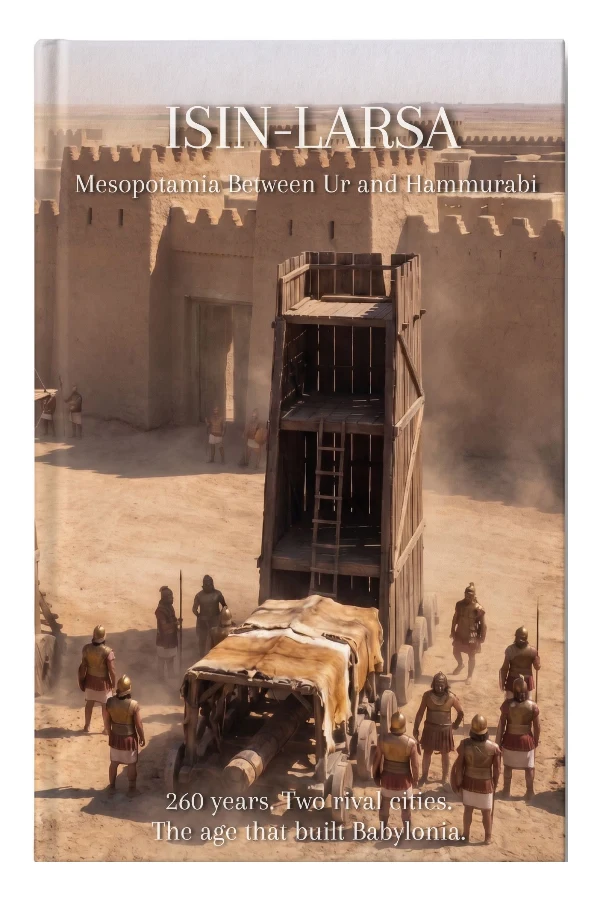
The Isin-Larsa Period: Mesopotamia Between Ur and Hammurabi
A reader's journey through the dates, dynasties, maps and everyday evidence of the age that shaped Babylonia
Between the fall of Ur and the rise of Hammurabi lie roughly two hundred and sixty years that most accounts of Mesopotamia cross in a single paragraph. Two cities in southern Iraq, forty kilometres apart, spent generations competing for the inheritance of a fallen empire. Neither finished the job, and a dozen other kingdoms rose and vanished around them. That untidiness is the reason to read the era closely. Centralized states leave orderly government archives. Competing city-states leave loan contracts, lawsuits, private letters, school exercises and the accumulated paperwork of people making their own arrangements — which is why this period offers a kind of social access that the far better documented empire before it does not. This is a 48,000-word account across twenty-two chapters, written for the general reader. The political story runs at the front and the back; the society sits between them, where it explains the politics rather than decorating it. Chapters you will find inside: Chapter 1 — The Collapse That Made the Period Possible. Grain reached roughly sixty times its normal price in the last years of Ibbi-Sin, and provinces quietly stopped using his year names one by one. You will see exactly how a state failure is read off ordinary receipts, and why five contributing causes are better than one. Chapter 2 — Naming the Age: Dates, Boundaries and the Chronological Debate. Three defensible start dates, one very precise end date, and the sixty-four-year gap that makes two reliable reference works disagree about the same king. You will stop being confused by conflicting chronologies and know which convention any source is using. Chapter 5 — Lipit-Ishtar and the Written Law Collection. A prologue claiming divine appointment, roughly fifty provisions on boats, orchards, apprenticeship and inheritance, and an epilogue protected by curses. You will understand why specialists hesitate to call these texts codes, and what the case records actually show. Chapter 12 — Ea-nasir, Dilmun and the Gulf Copper Trade. The most reproduced cuneiform document in the world is a complaint about substandard metal. You will see the commercial system behind it: pooled capital, partnership contracts, inspection rights and reputation as enforcement. Chapter 13 — The Naditu and the Economic Life of Women. Inside a walled precinct at Sippar, women dedicated to the sun god bought land, leased it out, lent silver and went to court. You will get the numbers, the inheritance-strategy explanation for why families did this, and the honest limits of generalizing from them. Chapter 16 — Plimpton 322 and Old Babylonian Mathematics. A tablet written at Larsa lists fifteen right triangles in ordered sequence. You will get the three competing readings of what it was for, and why an unexcavated findspot leaves the question open. Chapter 22 — Reading the Period Today. Why there is no Isin-Larsa flag and what served the purpose instead, how the period's name shifts across eight languages, six misconceptions worth discarding, and a five-test method for judging any map or claim you meet on this subject. Where specialists disagree, both positions are given with their reasons. Where the evidence is thin, the book says so. Dates follow the Middle Chronology used by most museum catalogues, and chapter two explains that choice rather than assuming it. By the end you will be able to place any ruler of early second-millennium Mesopotamia in a working chronology, read a period map critically, explain how written law and contract-based credit reached Hammurabi rather than starting with him, and find the primary sources yourself in free translation. For readers of general ancient history, students meeting the Old Babylonian world for the first time, and anyone who has tried to research this era online and hit recycled facts, incompatible maps and dates that refuse to reconcile.
Book video
- Genre
- History & civilization
- Format
- Ebook
Bundle including this book
Liberal Arts Bundle
This book is also available as part of a bundle.
View bundle ↗