The El Omari Culture
How Egypt's Early Farmers, Herders and Fishers Lived at Wadi Hof on the Edge of the Nile Delta
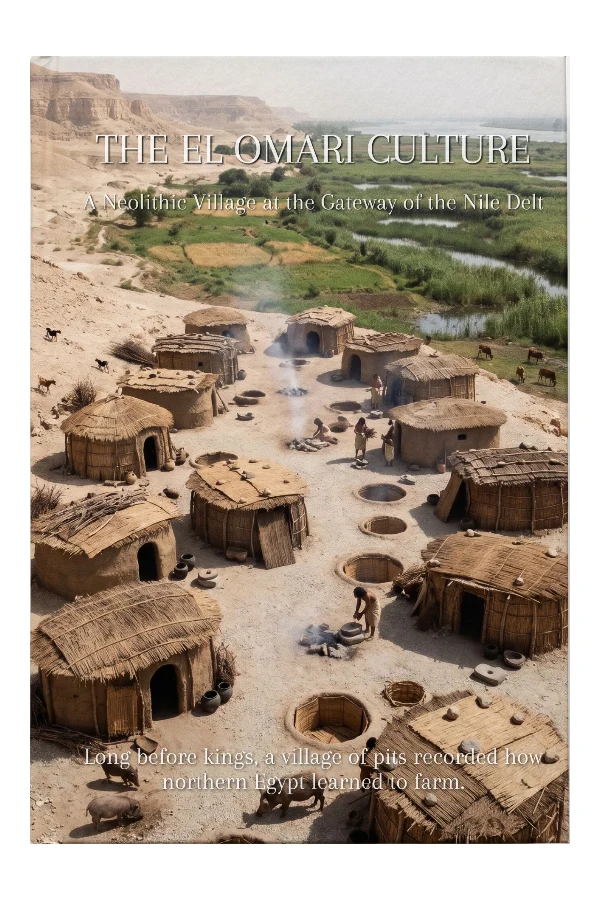
Long before Egypt had kings, crowns or pyramids, a community of farmers, herders and fishers lived on a gravel terrace just north of modern Helwan, where a dry desert valley called Wadi Hof meets the Nile. Archaeologists call them the El Omari culture. They left no monuments and no writing, only pits dug into the ground. Those pits turn out to be one of the richest records of everyday life in northern Egypt in the mid-fifth millennium BC. This book tells their story from the ground up. Drawing on the excavation report by Fernand Debono and Bodil Mortensen, its specialist studies of bones, plants and geology, and later research on the Neolithic of the Nile Valley, it reconstructs how the villagers lived, what they ate, how they worked and how they buried their dead. Along the way it explains in plain language how archaeologists know what they know, and where the evidence runs out. Inside you will find: Chapter 4: Wadi Hof and the Choice of Ground Why would farmers settle on gravel at the mouth of a desert valley? Discover how one location gave a community access to river, desert and spring water at once. Chapter 6: Counting the Centuries Websites give dates for El Omari that differ by five hundred years. Learn how radiocarbon dating works and how to tell a measured date from a repeated one. Chapter 7: Where Farming Came From Egypt's wheat, barley, sheep and goats had foreign ancestors. Follow the debate over how they arrived and what changed when they did. Chapter 13: Pigs Before Pharaohs The animal bones from El Omari hold a surprise about which creature the villagers kept most. See what the herds reveal about settled life by the Nile. Chapter 15: The River's Harvest From catfish to Nile perch, the village fished every kind of water around it. Understand why the river remained a pillar of life even after farming arrived. Chapter 20: The Man with the Staff One burial stands apart from all the others. Weigh what a single wooden object can and cannot tell us about leadership in an early farming village. Chapter 22: From El Omari to Maadi A few centuries later, a very different settlement rose nearby. Trace what changed and what endured as northern Egypt entered the age of copper and trade. Written for curious general readers as well as students of archaeology and Egyptology, this book explains every technical term as it appears and clearly marks what remains uncertain. It is a careful account of a small village that sits at the very beginning of the long story of Egyptian civilization. 23 chapters, about 48,000 words, with a bibliography of the principal sources.
Book video
- Genre
- History & civilization
- Format
- Ebook
Bundle including this book
Liberal Arts Bundle
This book is also available as part of a bundle.
View bundle ↗