Orosirian Period: Earth's Most Violent 250 Million Years
How Giant Asteroid Impacts and the Oxygen Revolution Created the Platinum, Gold, and Nickel Deposits Powering Modern Industry
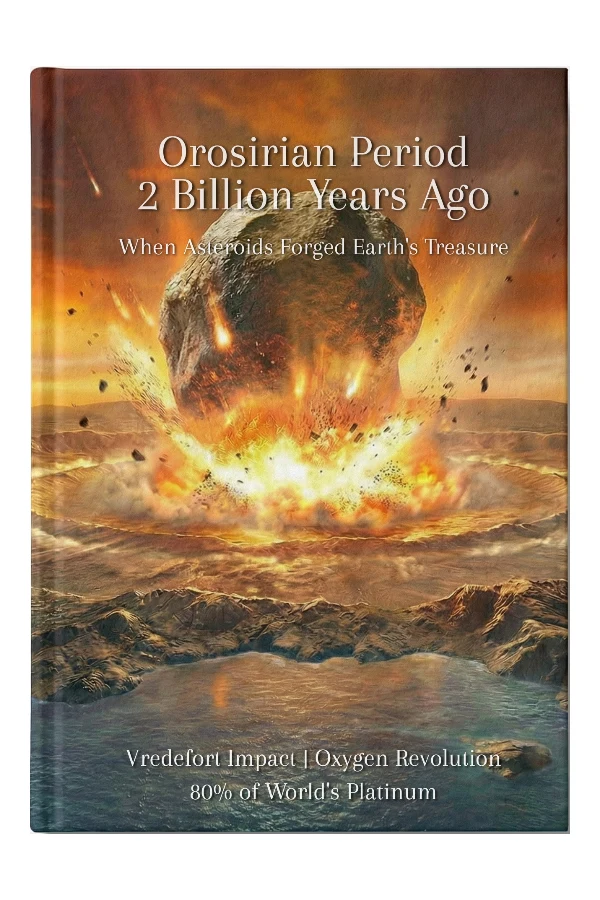
THE ERA THAT MADE YOUR SMARTPHONE POSSIBLE Take a breath. Now ask yourself: How did the oxygen you just inhaled become part of Earth's atmosphere? The answer lies in the Orosirian Period—250 million years of destruction, transformation, and miracle that most textbooks cover in a single paragraph. Between 2.05 and 1.8 billion years ago, Earth experienced: TWO of the largest asteroid impacts in planetary history The most dramatic atmospheric oxygen fluctuations ever recorded Continental collisions that raised Himalaya-class mountain ranges The birth of complex cells—the ancestors of all animals and plants This isn't ancient history. This is YOUR history. WHAT'S INSIDE: DIGEST TABLE OF CONTENTS Selected highlights from 15 in-depth chapters: Chapter 5: The Vredefort Impact — The Day the Sky Fell How a 15km asteroid created Earth's largest crater (300km) and triggered global "impact winter." Chapter 4: The Bushveld Complex — Birth of Earth's Greatest Treasure Vault Why 80% of all platinum comes from a single magma event 2.05 billion years ago. Chapter 9-10: The Sudbury Impact — Second Great Star Falls Another mega-asteroid 170 million years later created Canada's nickel capital. Chapter 2: The Oxygen Yo-Yo Phenomenon How wild oxygen swings may have triggered the evolution of mitochondria. Chapter 12: The Emergence of Eukaryotes When one cell swallowed another—the moment complex life became possible. Chapter 13: The Canfield Ocean — Sulfur-Scented Deep Sea The "poison ocean" that stalled evolution for a billion years. Chapter 7: Supercontinent Columbia How Earth's first supercontinent assembled and shaped modern plate tectonics. PLUS: Detailed geological timeline, technical glossary, community Q&A, and regional guide to Orosirian sites worldwide. WHY THIS MATTERS TODAY Approximately 80% of global platinum reserves were formed in the Orosirian Bushveld Complex The Sudbury nickel deposits power modern EV batteries and stainless steel Approximately 40% of humanity's gold may owe its preservation to the Vredefort Impact The platinum in your car's catalytic converter. The nickel in your smartphone battery. The gold in your jewelry. All of it traces back to 2 billion years ago—to destruction that became treasure. FOR READERS WHO: Love deep-dive science content with real-world applications Want to understand Earth's hidden history Appreciate connections between ancient geology and modern technology Enjoy clear explanations of complex topics
- Genre
- Space & science
- Format
- Ebook