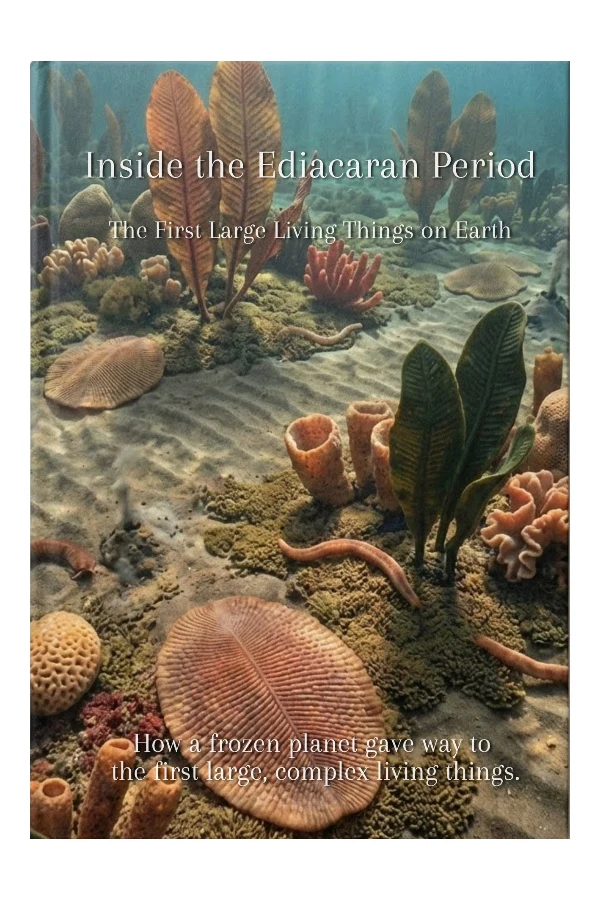
Inside the Ediacaran Period
Learn How Fossils, Rocks and Chemistry Reveal the First Large Living Things and the Frozen World That Came Before Them
Long before the first trilobites, Earth's seas held organisms that still puzzle scientists: flat quilted ovals, fractal fronds anchored in deep water, and tiny crawlers that left trails across living mats of microbes. This book is a clear, evidence-based account of the Ediacaran Period, the final chapter of the Precambrian, and of the organisms that made it famous. Written for curious readers with no special training, it explains how the period was defined, how its rocks are dated, what the planet looked like, and how a century of discoveries changed our picture of early life. Throughout, it separates what is well established from what remains contested. A look inside: Chapter 2: The World Before: Snowball Ice and the Cap Carbonate The Ediacaran begins as one of the most extreme ice ages in Earth's history ends. You will see why the rock that marks the start of the period matters. Chapter 8: The Matground Seafloor The seafloor itself was alive, carpeted with microbes. You will understand why soft-bodied fossils were preserved at all. Chapter 10: Avalon: Deep-Water Forests of Newfoundland Some of the oldest complex communities lived in darkness, far below the waves. You will be able to picture how these early communities were organized. Chapter 14: Dickinsonia: An Animal Proven by Its Fat A fossil argued over for decades became a test case for a new kind of evidence. You will learn how chemistry entered the debate over what these organisms were. Chapter 19: The Nama World: Shells, Reefs and Predators At the end of the period, the first hard parts appear. You will see how skeletons and reefs changed the rules of life on the seafloor. Chapter 21: The First Mass Extinction? Many Ediacaran organisms vanish long before the period ends. You will understand how scientists test whether a disappearance is real. Chapter 25: Seeing, Collecting and Learning More These fossils can still be seen, and some can be visited. You will know where to look and how to judge what you read online. The book spans 25 chapters with notes on sources and a bibliography.
- Genre
- Space & science
- Format
- Ebook