The Old Babylonian Period Explained
Understand the Competing Dates, the Real Shape of Hammurabi's Empire, and How Ordinary People Lived in Ancient Mesopotamia
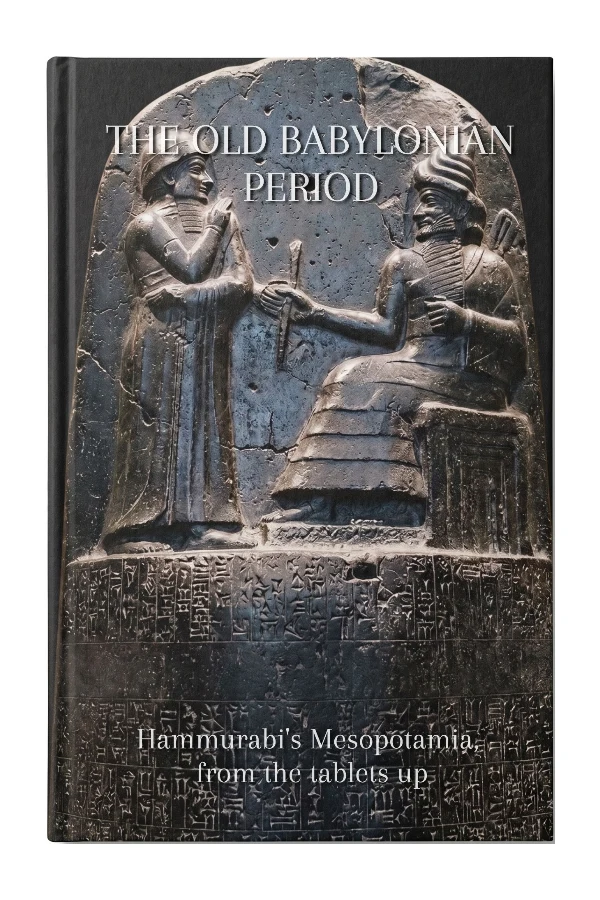
Hammurabi reigned for about forty-three years. He spent roughly twenty-nine of them digging canals and rebuilding temples. The conquests that made his name took under a decade, the empire held at full extent for something like fifteen years, and his son had lost the far south within about eleven years of inheriting it. That gap between the reputation and the record runs through the whole period, and closing it is what this book is for. The Old Babylonian era is the first stretch of human history from which ordinary voices survive in volume. Not only royal inscriptions, but loan contracts, marriage settlements, lawsuit records, school exercises, shepherds' accounts, and tens of thousands of letters. Twenty-four chapters, roughly fifty thousand words, written for readers who want to see the reasoning and not just the conclusions. WHAT YOU WILL BE ABLE TO EXPLAIN Why reputable books give three different date brackets for the same period, and which one the recent scientific evidence supports. How a silver economy without coins actually settled a debt, and why kings periodically declared those debts void. Why the most famous law text in the ancient world appears to have played no part in deciding actual cases. What really emptied the southern cities, and why the explanation most people have heard does not fit the timing. A SELECTION OF CHAPTERS Fixing the Dates: Why Every Book Gives You Different Numbers. Hook: a damaged astronomical tablet produces four possible answers, sixty-four years apart. Benefit: you will be able to read any date in any book on this subject and know exactly what it rests on. Hammurabi's Wars and the Making of an Empire. Hook: twenty-nine years of near silence, then eight years that redrew the map. Benefit: you will understand what triggered the expansion and why the structure could not outlive the man who built it. The Laws of Hammurabi. Hook: a monument recovered in Iran, stolen six centuries after it was carved, that judges seem never to have cited. Benefit: you will be able to say what the text actually was, which is a harder and more interesting question than what it said. Silver, Debt, and the King's Remission. Hook: royal proclamations that cancelled consumption debts while deliberately protecting commercial ones. Benefit: you will see how a pre-coinage credit system worked and why it kept producing the same crisis. Marriage, Family, and the Women of the Cloister. Hook: a walled quarter at Sippar whose celibate residents controlled estates of twenty-five hectares and lent silver at interest. Benefit: you will get an evidence-based answer on women's legal and economic position, rather than a slogan in either direction. The Tablet House: How a Scribe Was Made. Hook: one excavated house, fifteen hundred tablet fragments, and a clay recycling basin in the courtyard. Benefit: you will know the actual order in which a child learned to write, reconstructed from the physical evidence. The Late Old Babylonian Period: A Kingdom Contracting. Hook: cities occupied for two thousand years falling silent within a decade of each other. Benefit: you will be able to weigh the competing collapse explanations against what the documents and the survey data actually show. HOW IT IS WRITTEN No background in ancient history is assumed. Every technical term is explained where it first appears. Contested claims are marked as contested, and the reasoning behind each position is given so you can judge it yourself. The book closes with a source list covering the standard critical editions, the major museum collections, and the free online corpora through which any reader can now consult the primary documents directly.
Book video
- Genre
- History & civilization
- Format
- Ebook
Bundle including this book
Liberal Arts Bundle
This book is also available as part of a bundle.
View bundle ↗