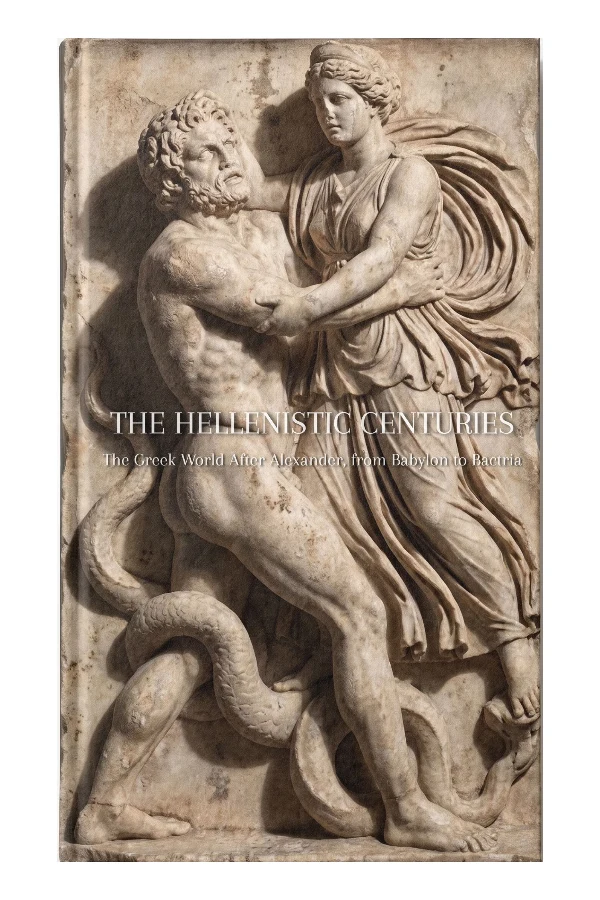
The Hellenistic Centuries
What Happened to the Greek World After Alexander, and Why Those Three Hundred Years Still Shape How We Think
Most people finish their schooling with two images of the ancient world. The first is the Parthenon: white marble, Pericles, tragedy performed under an Athenian sun. The second is a Roman legion. Between those two pictures sits a gap of roughly three hundred years that almost nobody can describe. That gap has a name, and it produced the Greek in which the New Testament was written, the first serious measurement of the planet, the identification of the brain as the seat of the nervous system, a geared astronomical instrument recovered from a shipwreck, and the sculpture that taught Western art how to show pain. This is a book for the reader who has run into the term on a museum label, in a syllabus, in a biblical commentary, or in a strategy game, and wants a real account rather than a paragraph — one that names the arguments instead of hiding them. A look inside: Chapter 2 — The Dates: When the Age Begins and Ends Hook: Three historians, two confident answers, and one lecture about why the question is malformed. You get: A precise answer you can give in one sentence, plus the reason 30 BCE and 31 BCE are both defensible, and why the period ended in Macedon in 168 BCE and in northwestern India in the first century CE. Chapter 5 — The Wars of the Successors Hook: A general steals a corpse, and forty years of war follow. You get: The one shape that makes this notoriously confusing period navigable, from Babylon to Ipsus to Corupedium, and why a unified empire was never recoverable. Chapter 9 — Alexandria and Pergamon: The Invention of the Research City Hook: Ships entering the harbour were searched for books. You get: How state-funded open-ended research was invented once, in Egypt, and what the Library's famous scroll numbers actually rest on. Chapter 10 — Measuring the Earth and Building Machines Hook: A scholar works out the size of the planet with a stick, a well, and a walking distance. You get: Eratosthenes' method and the honest answer about its accuracy, plus the 2024 research result that changed how the Antikythera mechanism's front dial is read. Chapter 12 — Epicureans, Stoics, Sceptics, Cynics Hook: Four schools, one shared promise: a mind that circumstance cannot reach. You get: What each school actually taught, why "epicurean" came to mean the opposite of what Epicurus said, and how Stoic cosmopolitanism ended up underwriting modern rights language. Chapter 18 — Judea, the Septuagint, and the Maccabean Crisis Hook: The conflict began as an argument among Jerusalem's own elite about what kind of city they wanted. You get: Why a Greek gymnasium in Jerusalem was a constitutional application rather than a sports facility, and the three competing scholarly explanations for what Antiochus IV did next. Chapter 21 — The Greek Cities of Afghanistan Hook: The oldest surviving copy of the moral maxims of Delphi is a stone on the Oxus, not a stone at Delphi. You get: What a French excavation found at Ai-Khanoum before 1978, and how Greek d
- Genre
- History & civilization
- Format
- Ebook