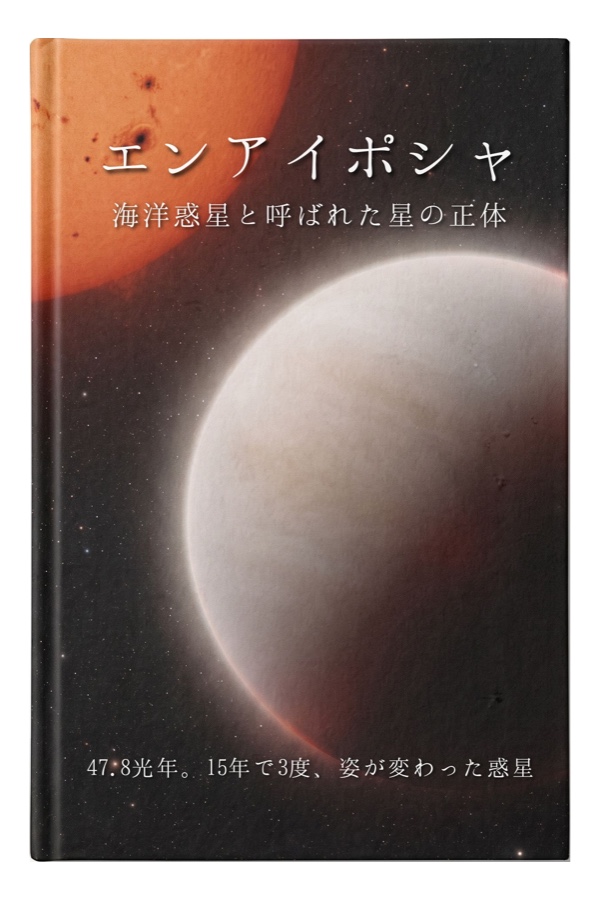
Enaiposha (エンアイポシャ)
Fifteen Years of Observations of a World Once Called an Ocean Planet
Japanese-language edition
In 2009, headlines around the world announced a water planet beyond our solar system. The object was small, orbiting a red dwarf 47.8 light-years away with a period of just 1.58 days. Its density was close to that of water, which led to a model in which the entire planet was covered by a deep ocean. That picture no longer holds. This Japanese-language edition follows more than fifteen years of observations of GJ 1214 b, formally named Enaiposha, across 21 chapters and 7 supplementary chapters. It traces how the ocean hypothesis arose, which observations cast doubt on it, and what replaced it. Chapter highlights Chapter 3 — The MEarth Project and the Discovery See how an array of small robotic telescopes matched the reach of far larger instruments. Chapter 7 — The Birth of the Ocean Planet Hypothesis Follow the reasoning that turned a low density measurement into a world covered by sea. Chapter 8 — Hubble and the Featureless Spectrum Understand why fifteen observations that detected nothing became a landmark result. Chapter 11 — The JWST Phase Curve Learn what a Bond albedo of 0.51 reveals about an atmosphere you cannot see directly. Chapter 14 — The Super-Venus Picture See how knowledge of Venus reshaped the interpretation of a planet 47.8 light-years away. Chapter 16 — What the Name Enaiposha Means Discover how a word from the Maa language entered the astronomical record. Chapter 17 — Comparison with TOI-1452 b Judge for yourself which of two worlds better fits the classical water-rich model. Technical terms are explained in plain language at first use. No background in astronomy is required. The video below is in Japanese.
- Genre
- Space & science
- Format
- Ebook