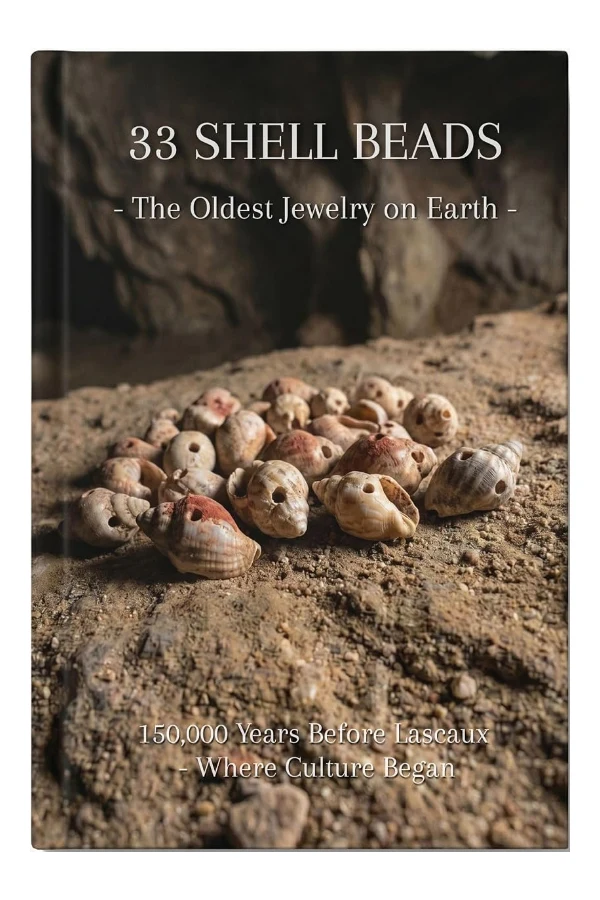
33 Shell Beads from Bizmoune Cave
How the World's Oldest Jewelry Rewrote 150,000 Years of Human Evolution, the Cognitive Revolution, and the Aterian Culture of Morocco
Deep inside a Moroccan limestone cave, an international team of archaeologists uncovered 33 tiny seashells that no one was meant to eat. Drilled, strung, stained with red ochre, and worn against skin for years, these beads are the earliest known evidence that Homo sapiens had crossed a cognitive threshold: the ability to think in symbols. This book traces the full arc of that discovery and the questions it raises. Digest Table of Contents Chapter 1: The Discovery and Geographical Context Follow a Moroccan-American research team into a cavern east of Essaouira and learn why this region was a natural laboratory for early human culture. Reader benefit: Understand the specific conditions -- limestone preservation, coastal resources, flint deposits -- that made Bizmoune Cave a time capsule. Chapter 2: The Oldest Jewelry in the World Examine 33 beads made from Tritia gibbosula and Columbella rustica shells, and see what microscopic wear marks, drill holes, and ochre residue reveal. Reader benefit: Grasp why choosing an inedible snail species for decoration signals intention, not accident. Chapter 5: Symbols and the Birth of the Mind Explore the link between wearing a bead and possessing language, and why archaeologists consider personal ornaments the earliest "exosomatic memory devices." Reader benefit: See how a single drilled shell challenges the old boundary between instinct and culture. Chapter 6: A New Timeline for the Cognitive Revolution Learn why the "40,000-year European revolution" model has collapsed and what replaced it. Reader benefit: Understand how 150,000-year-old evidence from North Africa rewrites the calendar of human creativity. Chapter 10: The Social Network of the Stone Age Discover how identical bead styles spread across thousands of kilometers and functioned as trust markers during environmental crises. Reader benefit: See parallels between ancient bead networks and modern social-identity systems. Chapter 12: The Impact on Human Evolutionary Theory Examine the Pan-African model of evolution and why North Africa now stands alongside East and South Africa as a cradle of culture. Reader benefit: Update your mental map of where and how Homo sapiens became "modern." Appendix E: In-Depth Q&A (20 questions) From "Were beads a form of currency?" to "Did they also have language?" -- detailed, research-grounded answers. Reader benefit: Resolve the most common curiosities in one place.
- Genre
- Space & science
- Format
- Ebook